
The JAMA Cannabis Review: A Physician’s Reality Check on Risk, Evidence, and Misinterpretation: what it’s really saying
This week, the latest JAMA cannabis review is getting passed around like a verdict. It is not one. It is a summary of an uneven body of research, written for clinicians, and it deserves to be read the way we read any review: with attention to what it can support, and equal attention to what it cannot.
What follows is my walk-through from my critical POV. The goal is not to cheerlead for cannabis, nor is my aim to scold it. The goal is to keep the science honest, and keep the conclusions proportional.
We live in times where media cares less about empowering critical thinking in its readers with even-handed delivery of scientific info, and more cherry-picking studies to suit a particular readership. This isn’t concerning of itself. Science has been delivering evidence on opposing sides of most issues, forever. The troubling part is when nobody in media is presenting the other side,
Thanks for learning with me. Here we go:
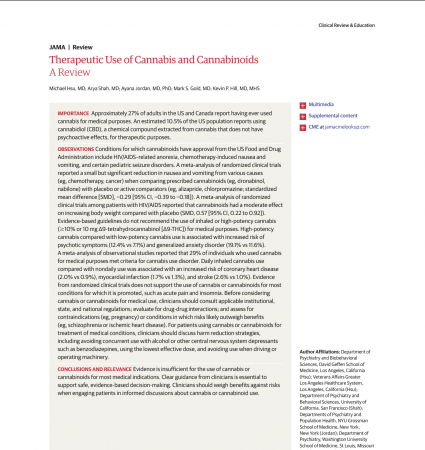
Quick summary
If you only read one paragraph, read this one. The review is useful, but it is not definitive. The biggest interpretive mistakes happen when observational associations are treated like causal proof, when “cannabis” is treated as a single standardized intervention, and when modest average effects are mistaken for no clinical value. In practice, the right response is neither hype nor fear. It is screening, better exposure definitions, careful dosing, thoughtful route selection, and monitoring function over time.
To read Dr Caplan’s takeaways for clinicians: click here
Source article I’m reviewing
Therapeutic Use of Cannabis and Cannabinoids: A Review of the Evidence
Journal: JAMA (Journal of the American Medical Association)
Authors: Kevin P. Hill, MD; Deepak Cyril D’Souza, MD; Susan L. Weiss, PhD; and colleagues
Year: 2025
When I refer to “the JAMA review” below, I mean that specific article.
1) Why this is not a verdict
This is not a randomized controlled trial, and it does not present new patient-level data. It is a clinical review, which means it synthesizes a large, messy literature and tries to translate it into something clinicians can hold in their hands. That is a legitimate goal, and sometimes a necessary one.
The limitation is baked into the format. In a review, the story you walk away with depends heavily on what the authors emphasize, how they group studies, which endpoints they treat as “meaningful,” and what they choose to call “insufficient.” All of that can be reasonable, and still be incomplete.
I often think of narrative reviews like a map drawn with a thick marker. You can see the coastlines. You can spot the mountains. But you cannot use it like turn-by-turn navigation. When people treat this kind of paper like GPS, overconfidence follows, and that is where risk interpretation gets distorted.
This matters because two very different things can be true at the same time. Observational signals can be worth taking seriously, and still be far from causal confirmation. Trial results can be modest on average, and still include meaningful benefits in a subset of patients, especially when dosing, products, and endpoints are misaligned with real-world use.
This is why “insufficient evidence” should not be translated as “no benefit.” It usually means the available studies cannot support high-confidence conclusions across a wildly variable set of products and use patterns.
Related: A deeper explanation of the endocannabinoid system
2) What the review gets right
A fair critique starts with what the review does well. First, it repeatedly signals a truth that still gets ignored in public debate: “cannabis” is not one standardized medication. That matters for both efficacy and safety.
Second, it draws a meaningful line between pharmaceutical-grade cannabinoids and the variable products people actually buy and use. Standardization makes trials interpretable. Variability makes results noisier. That is not a moral statement. It is a measurement statement. If we want stronger medical evidence, measurement has to improve.
Third, it highlights real risk domains that deserve clinical seriousness, including higher-potency THC exposure in younger populations, and the reality that problematic use patterns can occur, including among people who began with symptom relief as their intention. Those are not comfortable conversations, but medicine is not supposed to avoid uncomfortable conversations. It is supposed to make them accurate, specific, and humane.
The review’s strongest contribution may be its tone of caution. In a field that swings between enthusiasm and alarm, caution can be stabilizing. The problem is when caution becomes blunt, and bluntness becomes a substitute for nuance.

3) The category problem: “cannabis” is not one exposure
A large share of confusion in cannabinoid medicine comes from a basic category error. We use the word “cannabis” as if it names a single intervention. It does not. It names a family of exposures whose effects depend on composition, dose, route, timing, and the physiology of the person using it.
If we studied “food” as a therapy, we would not lump oatmeal and buffalo wings into one category and conclude that “food has modest benefit.” Cannabis research often does the equivalent. Low-dose balanced formulations and repeated exposure to high-potency concentrates are grouped under one umbrella. The average effect then looks smaller, less reliable, and harder to translate into patient care.
The key variables are not exotic. They are basic pharmacology and basic clinical context: THC to CBD ratio, total dose, titration strategy, route of administration, onset kinetics, duration, time of day, and frequency. The person matters too: age, sleep debt, stress load, psychiatric vulnerability, cardiometabolic risk, medications, and goals of care.
When studies do not measure these variables, true benefit signals get diluted, and risk signals get flattened into overly broad warnings. This is one reason cannabis research limitations are often measurement limitations, not proof that cannabinoid medicine lacks therapeutic relevance.
It also makes comparisons to alternatives harder. Someone replacing nightly alcohol with a carefully titrated cannabinoid regimen is not in the same risk-benefit scenario as someone escalating high-potency inhaled THC throughout the day. But both may be counted as “cannabis use” in observational datasets.
Related: Practical dosing, timing, and route considerations
4) Placebo, expectancy, and the blinding problem
Many outcomes in cannabinoid studies are subjective: pain ratings, sleep quality, nausea, anxiety, spasticity. That does not make them weak. It makes them human. But subjective outcomes are also more sensitive to expectancy effects and placebo response.
Placebo is often spoken about like a trick. In reality, placebo is physiology responding to expectation, context, and meaning. In symptom-driven trials, placebo response can be substantial. That means a “modest” average effect can still translate into meaningful relief for a subset of responders, especially when the right endpoints are used.
Then there is functional unblinding. THC can change perception and cognition in ways that make participants correctly guess they received the active drug. When that happens, patient-reported outcomes become partly pharmacology and partly expectation. This challenge is not unique to cannabinoids, but cannabis trials do not always quantify blinding integrity or incorporate it into interpretation.
A scientist-level reading should ask: were responder thresholds reported, not just mean differences? Were outcomes chosen that reflect function, not only symptom scores? Was titration allowed, or was a fixed dose imposed that does not resemble real-world care?
These questions do not weaken the science. They make it honest. They also guard against two opposite errors: overclaiming modest benefits as proof of robust efficacy, and dismissing modest benefits as “just placebo” without asking whether a clinically meaningful subgroup is benefiting.
Related: Cannabis and sleep, what evidence can and cannot show
5) Cardiovascular risk: what the data suggest, and what they cannot prove
If you want to understand why this JAMA review is making waves, start here. Cardiovascular risk is the most headline-friendly part of the discussion, and it is also the easiest place for nuance to get crushed.
The review cites observational findings in which frequent cannabis use, including daily inhaled use in some datasets, is associated with higher prevalence of cardiovascular diagnoses. That is a signal worth noticing. It is not a verdict. Observational signals are a reason to ask better questions, not a license to announce causality.

Prevalence is description, not a timeline
A common interpretive mistake is to treat prevalence differences as if they prove cannabis caused an event. Prevalence tells you two things travel together. It does not tell you which one came first, and it does not tell you what else came along for the ride.
Here’s an analogy I use because it is simple and it stays true. If you observe that people carrying umbrellas have a higher prevalence of pneumonia, that association might be real, but umbrellas are not the cause. Umbrellas cluster with rain, cold exposure, crowding, and seasonality. In epidemiology, umbrellas become a proxy variable.
Cannabis use can behave like an umbrella variable too. It may cluster with sleep disruption, chronic stress load, psychiatric comorbidity, tobacco co-use, alcohol patterning, stimulant exposure, and socioeconomic instability. If those variables are not measured well, or not measured at all, the “cannabis” variable starts absorbing them.
“Daily inhaled cannabis” is not a single exposure
In cardiovascular research, exposures are often measured precisely. Blood pressure is measured. LDL is measured. A1c is measured. Tobacco exposure, at its best, is quantified over time. Cannabis exposure is rarely measured with comparable fidelity in large population datasets.
Most surveys rely on self-report and broad frequency categories. They often cannot capture THC dose, potency, route details, inhalation depth, combustion versus vaping, nicotine mixing, or product composition. The phrase “daily inhaled cannabis” can represent profoundly different pharmacologic realities.
One person may take a low-potency inhalation once nightly for sleep. Another may use high-potency concentrates repeatedly through the day. Another may be mixing cannabis with tobacco or nicotine products in ways that are not reliably disclosed or captured. When those exposures are treated as the same thing, interpretation becomes soft around the edges.
Residual confounding is not a footnote, it is the main event
Even when studies adjust for age, sex, and smoking status, residual confounding can remain substantial. The confounders most likely to distort cannabis and cardiovascular associations are often poorly measured: lifetime tobacco exposure rather than current smoking only, binge alcohol use, stimulant exposure, sleep debt, psychiatric illness, chronic stress, diet, physical activity, and healthcare access.
This is where effect size matters. Modest risk ratios, even when statistically significant, are more vulnerable to residual confounding and measurement error. This is not an argument to ignore them. It is an argument to interpret them with humility, and to resist translating them into sweeping causal claims.
Reverse causation is plausible
Many datasets do not establish whether cannabis use precedes cardiovascular diagnosis or follows it. That matters. People change behavior after illness. Some increase cannabis use after a cardiac event because sleep is broken, pain is persistent, anxiety increases, or activity decreases.
If cannabis use increases after diagnosis, cannabis can look like a risk factor even when it is partly a response to illness. That is reverse causation, and it cannot be fully addressed without longitudinal measurement and careful time sequencing.
Clinical framing: risk is rarely binary
The clinically useful questions are not “does cannabis increase cardiovascular risk, yes or no.” The useful questions are: in whom, under what conditions, at what dose, by what route, and relative to what alternative exposures?
A patient substituting a carefully titrated cannabinoid regimen for nightly alcohol is in a different risk landscape than a young patient escalating high-potency inhaled THC while sleep deprived and co-using nicotine. Those two scenarios can collapse into the same “daily use” category in an epidemiologic dataset, but they should not collapse in clinical care.
So yes, the signals warrant screening and counseling. They warrant sober attention to route, potency, nicotine co-use, baseline cardiovascular risk, and the reasons a person is using cannabis in the first place. What they do not warrant is a blanket story that treats all cannabis use as a cardiovascular hazard.
Related: Cannabis and heart health, what clinicians should watch for
6) Psychiatric risk, potency, and developmental vulnerability
The psychiatric section of the review is important, and it is also the place where public discussion often becomes the least disciplined. The risk signals are real. They are also not evenly distributed across ages, formulations, or patterns of use.
When nuance disappears, people walk away with statements like “cannabis causes psychosis” or “cannabis is bad for mental health.” Those phrases are too broad to guide a patient, and too blunt to represent what the evidence actually shows.
Potency behaves like a dial
A consistent pattern in psychiatric risk data involves higher-potency THC exposure. In certain observational cohorts, higher potency and more frequent use are associated with higher rates of adverse psychiatric outcomes. From a pharmacology standpoint, this should not surprise anyone.
Potency is not a moral category. It is a dose category. It behaves like a volume dial. Turn it up and you increase the probability of unwanted effects, especially in vulnerable individuals.
Clinically, I think about potency the way I think about alcohol content or benzodiazepine dose. Higher intensity changes risk. It changes impairment. It changes the likelihood of panic, paranoia, and destabilization in those who are prone to it.
Adolescence is a distinct risk window
The strongest psychiatric risk signals are concentrated in adolescents and young adults. The adolescent brain is still developing, and early initiation with high-frequency use appears to amplify risk, particularly in those with underlying vulnerability.
That is a legitimate public health concern. It is also a mistake to treat adolescent recreational cohorts as interchangeable with adult therapeutic populations receiving clinician guidance and using lower doses for symptom relief. Those are different exposures, different developmental contexts, and often different baseline risks.
Anxiety is likely bidirectional
Anxiety and cannabis use commonly travel together in population datasets. The crucial question is directionality. Many anxious individuals use cannabinoids to self-regulate sleep, autonomic hyperarousal, or distress. Cannabis can also provoke anxiety, especially at higher THC doses, rapid-onset routes, or in those prone to panic.
Both can be true simultaneously. Observational data cannot reliably disentangle cause from coping without time-stamped exposure measurement and careful adjustment for baseline anxiety severity. So “associated with anxiety” should not be translated to “causes anxiety” without stronger evidence.
From a clinical standpoint, the actionable message is practical: screen for panic vulnerability, encourage titration, consider CBD-rich or balanced formulations when appropriate, and monitor response over time.
Psychosis risk is concentrated, not universal
Psychosis is rare but serious. Cannabis can precipitate psychotic symptoms in predisposed individuals, and the risk appears higher with early initiation, high-frequency use, and high-potency THC exposure.
That pattern aligns with a vulnerability model, not a universal danger model. The clinical implication is screening and caution, not moral panic. People with a personal or strong family history of psychotic disorders, or those with emerging symptoms, should be counseled differently. Precision matters here more than slogans.
Related: Cannabis and anxiety, with practical clinical guidance
7) Cannabis use disorder: where diagnosis, biology, and context get tangled
Few phrases generate more heat than “cannabis use disorder,” and the JAMA review is careful to acknowledge that problematic use patterns exist, including among people who identify as medical users. That acknowledgment is appropriate. The difficulty lies in how easily the diagnosis is interpreted without sufficient clinical context. I’ve shared my thoughts on Cannabis Use Disorder as a diagnosis via my Substack here and I’ve written about the crtiical differences between cannabis addiction and dependence here.
To understand why this matters, it helps to separate three things that often get collapsed into one: physiologic dependence, behavioral dysregulation, and therapeutic persistence.
Dependence is biology, not a moral failure
Many medications used legitimately in medicine produce physiologic dependence. SSRIs, benzodiazepines, beta blockers, corticosteroids, and opioids all induce adaptation in the nervous system. Withdrawal phenomena occur when they are stopped abruptly. This is basic pharmacology.
When patients develop dependence on these medications, clinicians do not automatically diagnose addiction. We ask whether function is improving, whether doses are escalating, whether control is lost, and whether harm outweighs benefit. Context matters.
In cannabis research, that distinction is often blurred. A patient using cannabinoids daily for chronic pain or severe insomnia may meet criteria for tolerance or withdrawal without exhibiting compulsive, destructive, or chaotic behavior. Labeling that pattern as “disorder” without nuance risks confusing biology with pathology.
Diagnostic criteria can over-capture medical persistence
The DSM criteria for cannabis use disorder include elements such as time spent obtaining the substance, continued use despite problems, and difficulty stopping. In medical contexts, these criteria can sometimes capture persistence rather than pathology.
Time spent obtaining cannabis may reflect regulatory barriers rather than compulsive seeking. Continued use may reflect symptom recurrence when the therapy is stopped. Difficulty stopping may reflect rebound symptoms rather than loss of control.
This does not make cannabis use disorder a meaningless diagnosis. It means it requires clinical interpretation rather than checklist application. Function, trajectory, intent, and collateral harm all matter.
Route and onset speed shape reinforcement
One of the most robust principles in addiction science is that faster onset increases reinforcement potential. Rapid delivery strengthens learning loops. From this perspective, route of administration matters enormously.
Inhaled high-potency THC produces faster onset and higher peak effects than oral or sublingual routes. Concentrates amplify this effect further. When datasets fail to stratify by route and potency, dependence risk is flattened into a single prevalence estimate that obscures actionable differences.
Clinically, this is where harm reduction lives. Slower-onset routes, lower potency, and titration to the minimal effective dose reduce reinforcement risk. The review gestures toward these ideas, but they deserve to be central rather than peripheral.
Related: Is cannabis addictive? A clinician’s explanation
8) When harms and benefits are held to different standards
One of the quiet forces shaping how readers experience the JAMA review is evidentiary asymmetry. Benefits and harms are not always judged by the same standards, even when the underlying data share similar limitations.
Potential benefits are typically evaluated through randomized controlled trials with fixed dosing, short duration, and narrow endpoints. When results are inconsistent or modest, the conclusion is often that evidence is insufficient. That is methodologically defensible, but it sets a high bar.
Potential harms, by contrast, are often inferred from observational associations in large datasets. These studies are valuable, but they are also vulnerable to exposure misclassification, residual confounding, and unclear temporality. Yet their conclusions are often treated with greater rhetorical confidence.
An analogy from the courtroom
Imagine two courtrooms operating under different rules. In the courtroom assessing benefit, evidence must be pristine. Any ambiguity weakens the case. In the courtroom assessing harm, patterns and associations are allowed to testify, even when mechanisms and timelines are uncertain.
Both courtrooms claim to serve truth. But they do not weigh evidence equally. This imbalance does not mean harms are invented. It means they sometimes carry more narrative weight than the quality of evidence alone would justify.
Effect size without context misleads in both directions
Small average effects are often framed as disappointing. But averages hide heterogeneity. In chronic symptom conditions, a modest mean effect can include a meaningful responder subgroup.
Conversely, modest risk ratios in observational studies can appear alarming when stripped of absolute risk context. Both errors stem from the same root problem: interpreting numbers without situating them in clinical reality.
Evidence-based medicine does not mean privileging one type of uncertainty over another. It means applying symmetric skepticism to benefit and harm claims alike.
9) When the research model does not fit the therapy
One of the deepest challenges beneath the review is not bias or intent. It is fit. The dominant research models used to study cannabis may be poorly aligned with how cannabinoids actually work in the body.
Cannabinoids primarily act on the endocannabinoid system, a regulatory network involved in sleep-wake cycling, stress response, pain modulation, appetite, autonomic tone, and emotional regulation. Regulatory systems do not behave like on–off switches. They behave like dials.
When dial-based systems are studied with short-duration, fixed-dose trials and narrow endpoints, results often look inconsistent or modest. This is not unique to cannabis. Similar challenges appear in psychotherapy research, sleep interventions, and lifestyle medicine.
Short trials compress time
Many cannabinoid trials last weeks, not months or years. That limits the ability to observe adaptive change, cumulative benefit, or gradual dose optimization. It also limits the ability to observe delayed adverse effects.
Clinical care unfolds over time. Trials that compress time can produce clean data that are still incomplete representations of real-world use.
Fixed dosing ignores variability
Sensitivity to cannabinoids varies widely. Some patients respond to very low doses. Others require higher exposure. Fixed-dose trials overshoot some participants and undershoot others.
When mismatched doses are averaged together, the signal shrinks. That does not mean the therapy failed. It means the design was blunt relative to the intervention.
Regulatory effects resist narrow endpoints
Cannabinoid effects often span multiple domains simultaneously: sleep quality, pain intrusion, autonomic regulation, mood stability. Narrow endpoints may miss this integrated effect.
A patient who sleeps better may report less pain, better mood, and improved function without dramatic movement on any single scale. The review acknowledges heterogeneity, but does not fully grapple with what that implies for trial interpretation.
Related: Why cannabinoids behave differently than single-target drugs
10) Substitution effects: the missing piece in most “risk” conversations
One of the biggest gaps in much of the cannabis literature, including what is summarized in this review, is substitution. Risk is often evaluated as if cannabis is being added into an otherwise stable system, rather than replacing something else.
In real clinical life, patients rarely use cannabinoids in a vacuum. Many use them in the context of other therapies. Some reduce or discontinue alcohol. Others reduce opioids, benzodiazepines, sedative-hypnotics, or polypharmacy for sleep and pain. Each of those exposures has its own risk profile, and in some cases that risk is substantial.
If we do not ask what cannabis is displacing, we cannot answer the question patients and clinicians actually care about: does this choice increase overall harm, reduce it, or simply move it around?
Net harm is a comparison problem
Public health often defaults to additive models. Add a substance, add a risk. Clinical medicine is different. Clinical decisions are comparative. They are about which option is safer and more effective for this person, under these conditions, relative to the alternatives they are realistically considering.
A patient choosing between nightly alcohol and a carefully titrated cannabinoid regimen is not making the same decision as a patient layering high-potency inhaled THC on top of other destabilizing exposures. Most large datasets do not capture this difference well, and many reviews, by necessity, do not model it.
That absence does not invalidate the review. It does mean that any risk framing that ignores substitution is incomplete.
Related: harm reduction principles in cannabinoid care
11) A brief note on the New York Times coverage
This review has not stayed within academic circles. It has spilled quickly into the public square, and the most visible example is the recent New York Times article discussing medical cannabis evidence and public perception.
That coverage has been read by a lot of people, and it has shaped the way patients and clinicians are talking about the subject. The broad themes are not wrong: evidence is mixed, products are heterogeneous, and the field is easy to misinterpret. The problem is that speed and simplicity often win over nuance.
In a fast publication cycle, heterogeneous studies tend to get flattened into one storyline. Observational associations start to sound like conclusions. Methodology becomes a footnote, and the limitations that should guide interpretation are often treated as technicalities rather than central facts.
What gets less oxygen in mainstream coverage are the issues that actually decide what we should do clinically: exposure misclassification, residual confounding, placebo response, functional unblinding, dose and route heterogeneity, and the mismatch between adolescent recreational cohorts and adult therapeutic populations. Those aren’t exotic caveats. They are the hinge points.
This is not a critique of journalism as a profession. Journalism plays an important role in translating science. It is a reminder that translation is not the same as clinical guidance, and certainty of tone is not the same as certainty of data.
If you want to read the Times coverage directly, it’s here: The New York Times article on medical cannabis evidence.
12) Generalizability: who do these findings actually apply to?
Another limitation that deserves to be stated plainly is generalizability. Much of the evidence summarized in the review comes from populations that are younger, more recreationally oriented, more polysubstance-exposed, and less clinically supervised than the typical medical patient.
That does not make the findings irrelevant. It narrows the confidence with which we can apply them. Extrapolating from heavy recreational use patterns to older adults using low-dose products for sleep or pain introduces uncertainty that is rarely emphasized in summaries or headlines.
The clinician’s job is to ask: does the patient in front of me resemble the population from which these findings are drawn? If not, caution should be proportional.
13) What clinicians should do with this review
After all the methodological nuance, the practical question remains: what should clinicians do differently on Monday morning?
The answer is not to disengage. Patients are already using cannabinoids. When clinicians step back, care becomes less safe, not more. The right response to imperfect evidence is informed participation.
Screen the patient, not just the substance
Cannabis does not act on a blank slate. Risk depends on age, psychiatric history, sleep stability, cardiovascular status, medications, and prior substance use. The review underscores this variability, but it does not turn it into a clinical workflow. We can.
Pay particular attention to adolescents, people with psychosis vulnerability, panic disorder, heavy nicotine or stimulant use, uncontrolled cardiovascular disease, and severe sleep deprivation. Those are not moral categories. They are physiologic vulnerability categories.
Break “use” into variables you can counsel on
Instead of “do you use cannabis,” ask how, how often, what dose, what kind of product, what time of day, and for what goal. Route, potency, and frequency shape both benefit and risk. This moves the conversation from stigma into medicine.
Match route and dose to the risk profile
Faster onset generally increases volatility and reinforcement risk. Slower routes and careful titration reduce that volatility. This is basic pharmacology applied to cannabinoids.
When risk is present, the solution is often adjustment, not prohibition.
Measure function, not just frequency
Frequency alone is a crude metric. The more useful questions are functional: is sleep improving, is pain less intrusive, is mood more stable, is medication burden reduced, is daily life more manageable?
A patient whose function is improving deserves a different clinical interpretation than a patient whose use is escalating alongside worsening outcomes, even if both use cannabis daily.
14) What patients should be told, plainly and honestly
The tone of counseling matters as much as the content. Fear-based messaging drives secrecy. Overconfidence drives harm. Honest counseling lives between those extremes.
Patients deserve a clear message: cannabis is not harmless, but it is not uniquely dangerous. Risks exist, particularly with high-potency products, frequent use, and early initiation. Benefits exist for some symptoms and some people. Evidence is mixed partly because the intervention is variable, and partly because the research models are imperfect.
Most importantly, patients should be invited into partnership. Open discussion allows monitoring, adjustment, and early intervention if problems emerge. Silence does not reduce use. It only reduces safety.

15) The takeaway: precision over panic
The most damaging misinterpretation of this review is to treat it as a final judgment. It is not. It is a careful synthesis of a difficult, evolving literature. It reflects both real concerns and real uncertainty.
Cannabis is not a miracle therapy. It is not a menace. It is a variable tool interacting with a complex regulatory system in complex humans. That reality demands precision, not slogans.
For clinicians, the path forward is straightforward. Engage rather than avoid. Screen rather than stereotype. Adjust rather than alarm. Track function rather than fixate on frequency. Apply the same evidence-based humility to cannabinoids that we apply to every other imperfect but potentially helpful therapy in medicine.
Precision, not panic, is how medicine moves forward.
Click here to read the full PDF of the JAMA article
Author: Dr. Benjamin Caplan, MD
Chief Medical Officer, CED Clinic
If you are a clinician or patient seeking evidence-based guidance on cannabis, explore our clinical resources at CEDclinic.com.
To read Dr Caplan’s takeaways: click here