Table of Contents
Physician’s Editorial Preface
I occasionally permit clearly labeled sponsored educational content on this site when the topic intersects with areas of active public confusion or regulatory ambiguity, and when the material can be presented without product endorsement or medical recommendation. The purpose of allowing such content is to support informed discussion, risk awareness, and literacy around evolving cannabis-related markets that patients and clinicians increasingly encounter in real-world settings. Sponsored placement does not influence my clinical views, does not substitute for peer-reviewed evidence, and does not imply that any product discussed is appropriate, safe, or recommended for individual use.
SPONSORED EDUCATIONAL CONTENT
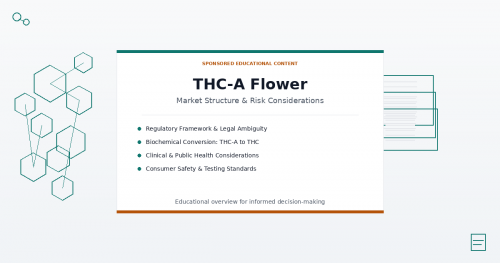
THC-A Flower: Market Structure, Regulatory Ambiguity, and Practical Risk Considerations
The commercial market for
THC-A flower
has expanded rapidly under the U.S. hemp framework, driven by regulatory interpretation, agricultural practices, and consumer demand. Although often presented as distinct from THC-dominant cannabis, THC-A flower occupies a legally and clinically ambiguous space that warrants careful explanation.
This article provides a non-promotional overview of the factors shaping the THC-A flower market and highlights considerations relevant to safety, legality, and consumer understanding. It does not constitute medical advice or product endorsement.
Core clarification
THC-A, or tetrahydrocannabinolic acid, is the naturally occurring precursor to THC found in raw cannabis flower. When heated, THC-A undergoes decarboxylation and converts into delta-9 THC, the compound responsible for intoxication and impairment. As a result, inhaled or vaporized THC-A flower can produce psychoactive effects similar to THC-dominant cannabis, regardless of how it is marketed.
This biochemical reality underlies many of the legal, clinical, and safety considerations associated with the category.
Structural Factors Shaping the THC-A Flower Market
Regulatory interpretation and enforcement variability
Federal hemp law defines legality by delta-9 THC concentration prior to heating. However, state-level statutes, agency guidance, and enforcement priorities vary widely. Some jurisdictions permit the sale of THC-A flower under hemp classifications, while others restrict or actively challenge it. This variability directly affects availability, distribution, and market stability.
Cultivation and production practices
THC-A flower products vary substantially based on genetics, cultivation methods, harvest timing, and post-harvest handling. These factors influence cannabinoid composition, consistency, and classification, contributing to heterogeneity within the marketplace.
Distribution and retail infrastructure
Differences in distribution networks, shipping policies, and retail access shape how products move between regions. These logistical factors contribute to uneven availability and regional pricing differences.
Supply dynamics and pricing
Pricing reflects a combination of agricultural yield, regulatory pressure, production costs, and consumer demand. As with other emerging cannabinoid categories, pricing remains sensitive to changes in legal interpretation and enforcement trends.
Transparency and documentation standards
The availability and quality of batch-specific Certificates of Analysis influence consumer trust and market credibility. Testing practices and disclosure standards vary across suppliers, and generalized claims should not be assumed to reflect individual product batches.
Clinical and Public Health Considerations
From a clinical and public health perspective, several issues are central to understanding THC-A flower products:
- Heated THC-A produces THC and may impair cognition, coordination, and reaction time.
- Use may result in positive THC metabolite findings on standard drug tests.
- Inhalation of combusted plant material carries known respiratory risks independent of cannabinoid content.
- Compliance with federal hemp definitions does not guarantee protection under state or local law.
- Products should be avoided during pregnancy or breastfeeding and kept inaccessible to children.
- Consumers should understand how to review batch-specific testing for contaminants such as pesticides, heavy metals, residual solvents, and microbial growth.
Closing Perspective
The THC-A flower market reflects the tension between biochemical reality, regulatory language, and commercial innovation. While marketed within hemp frameworks, these products can behave pharmacologically like THC-containing cannabis when used as intended. Clear understanding of this distinction is essential for informed decision-making.
Educational discussion of this market should prioritize transparency, risk awareness, and regulatory nuance rather than promotional framing.
Editorial Disclosure
This article is sponsored by a commercial entity. The publisher did not independently test or verify products discussed in the broader THC-A marketplace. Publication of this content does not imply medical endorsement or recommendation.
SPONSORED EDUCATIONAL CONTENT