
Table of Contents
Cannabis and Anxiety Relief in Real-World Patients: A 45-Day Longitudinal Look
Earlier today we published coverage of a separate neuroscience paper examining cannabis and brain reward anticipation over 12 months.
If you missed it, you can read that here:
The Association Between Cannabis Use and Brain Reward Anticipation (Nature)
That paper focuses on brain imaging and long-term neural adaptation. The study below asks something more immediate and more clinically practical: When patients use medical cannabis for anxiety in daily life, do they feel better that same day?
For ongoing research updates, visit our Cannabis News feed.
Full study manuscript (PDF): Download the published paper
Researchers followed 416 Florida medical cannabis patients certified for anxiety for 45 days. Each day, participants rated anxiety before and after whatever they used or did to manage symptoms.
On “cannabis-only” days, average anxiety dropped by about 3.5 points on a 0–10 scale. That is a clinically noticeable same-day change.
On days with other medications or only activities like exercise or meditation, anxiety still dropped, but by a smaller amount in this dataset.
This was not a randomized trial. People chose what they used each day. Expectancy, context, and standardized timing were not controlled.
The real question becomes not simply “does cannabis reduce anxiety,” but what portion of relief is cannabinoids, what portion is context, and what portion is expectation.
What This 45-Day Study Actually Did
The researchers collected over 11,000 day-level entries across 45 days. Each entry captured anxiety before and after the day’s chosen intervention. They compared day types: medical cannabis only, medications only, activities only, and combinations.
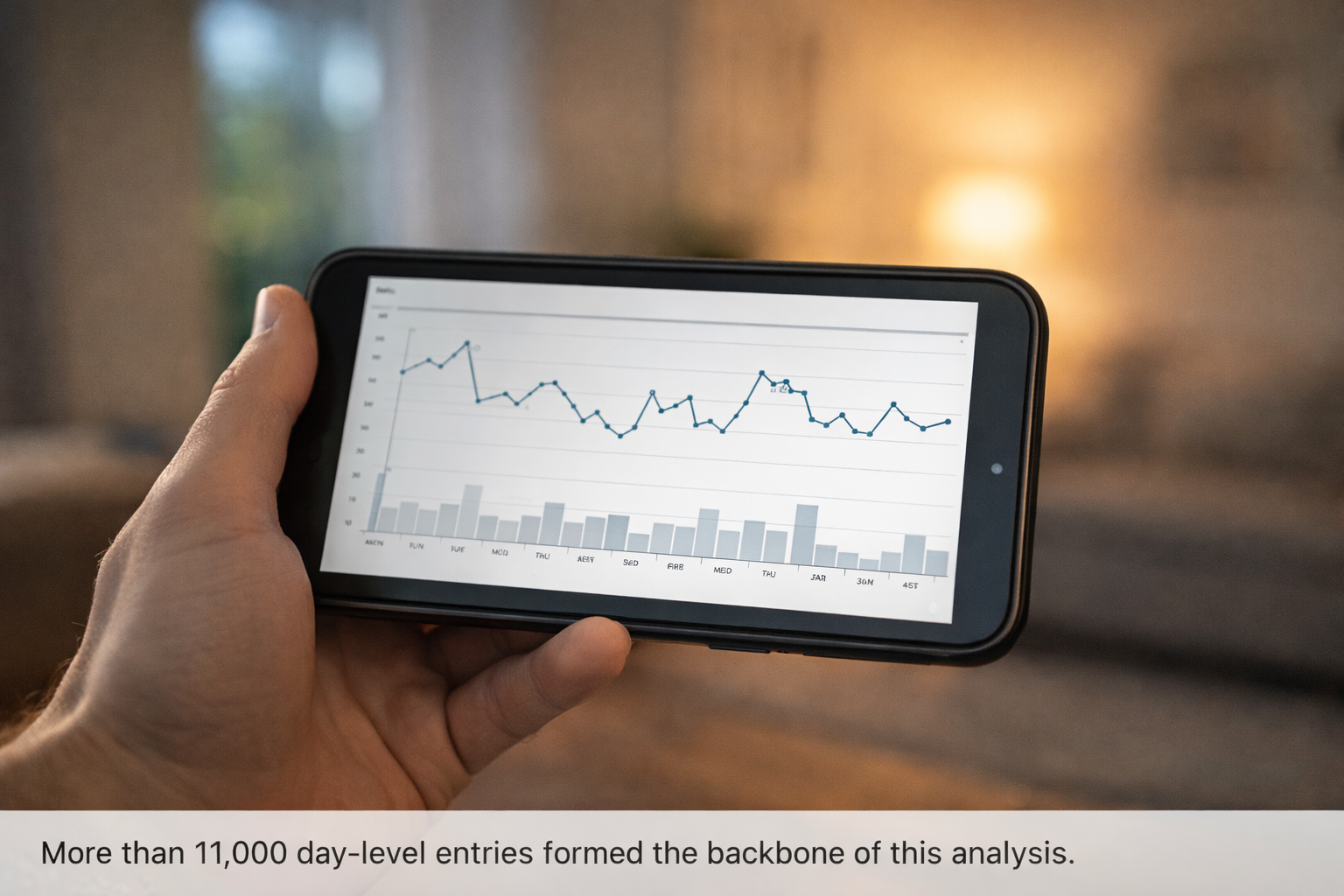
In this real-world symptom tracking cohort, cannabis-use days were associated with larger same-day reductions in anxiety than non-cannabis days. Relief did not appear to meaningfully decline across the 45-day window.
This is real-world cannabis evidence, not a lab demonstration. That is both the strength and the constraint.
Strengths
- Daily tracking reduces long-recall bias.
- Large day-level dataset improves analytic stability.
- Appropriate modeling for repeated observations within individuals.
- High ecological validity, reflecting how patients actually use medical cannabis for anxiety.
Limitations
- No randomization or blinding.
- No measurement of expectancy or belief effects.
- No standardized dosing and no cannabinoid composition modeling (THC, CBD, ratios).
- Self-selection into cannabis use and into the study itself.
- Day-type comparisons may reflect differences in context, not only differences in substances.
None of these invalidate the reported reductions. They limit what the data can prove. That distinction is not semantic. It is the difference between patient experience and pharmacologic causality.
What This Study Is Actually Telling Us
In my clinic, this is the exact conversation patients want clarity on. They are not asking whether cannabis “treats anxiety disorders” in the abstract. They are asking: When I use it, do I feel calmer?
This study suggests that many treatment-seeking patients do report meaningful same-day relief on cannabis-use days. That matters. It puts numbers behind an experience that is otherwise easy to dismiss or exaggerate.
Here is the part the public conversation tends to miss. If a patient reports relief, that relief is real, even if we cannot yet assign credit cleanly between cannabinoids and context. But if we pretend this kind of real-world data “proves” cannabis is a universal anxiolytic, we create the opposite problem: people who are THC-sensitive, or who worsen with the wrong product, get told they are “doing it wrong.” That is not evidence-based care. That is ideology wearing a white coat.
As your physician, my job is to go one step further: who benefits consistently, who worsens, what dose range is safest, what THC:CBD balance fits your physiology, and what role does context play. This paper moves us forward. It does not finish the job.
Why Expectancy Matters in Cannabis and Anxiety Research
Anxiety is particularly sensitive to anticipation and perceived control. When patients believe something will calm them, measurable reductions in distress can occur even before pharmacology fully unfolds.
In blinded randomized trials, expectancy is partially controlled. In real-world symptom tracking studies like this one, it is not. That does not make relief unreal. It means mechanism remains layered.

This is also where product chemistry matters. If you are trying to make sense of what you are taking and what it actually contains, start with: how to read a Certificate of Analysis (COA) .
- Daily research updates: Cannabis News
- Basics and context: What is the endocannabinoid system?
- Product literacy: How to read a COA
- Related clinical topic: Medical cannabis for anxiety
Executive Summary
- 416 medical cannabis patients tracked anxiety daily for 45 days.
- Cannabis-use days showed larger same-day reductions in anxiety than non-cannabis days.
- Effects were clinically noticeable in magnitude within this cohort.
- No randomization, no expectancy measurement, and no dose modeling limit causal conclusions.
- Best interpreted as strong evidence of perceived benefit in engaged medical cannabis patients.
Real-world data tell us how patients experience treatment. Controlled trials tell us why. Responsible medicine integrates both.