Table of Contents
- How Mindless Parts Create Intelligent Wholes, and What That Means for Your Health
- 5 Stunning Ways Emergent Systems in Biology Shape Your Life
- What You’ll Learn in This Post
- Table of Contents
- Swarm Intelligence: When the Colony Knows What No Ant Could Know
- The Wisdom Without a Thinker: Flocks, Schools, and the Beauty of Simple Rules
- Slime, Solve, Succeed: When Single Cells Outsmart Engineers
- From Cells to Selves: The Emergence of You
- The Quiet Orchestration Beneath Awareness
- Emergent Systems All Around Us: Traffic, Markets, and the Grammar No One Wrote
- Consciousness: The Hard Problem and the Humble Mystery
- Why Emergence Matters for Your Health: Restoring the Conversation
- 10 FAQ About Emergence
- 1. What are emergent systems in biology?
- 2. How does emergence explain consciousness?
- 3. Can slime mold really solve complex problems?
- 4. What is swarm intelligence and how does it work?
- 5. How do emergent systems relate to human health?
- 6. What is the endocannabinoid system’s role in emergence?
- 7. Why do birds flock in murmurations?
- 8. How can understanding emergence improve medical treatment?
- 9. What everyday examples demonstrate emergence?
- 10. Is emergence the same as complexity?
- Returning to the Murmuration: A Closing Reflection
How Mindless Parts Create Intelligent Wholes, and What That Means for Your Health
5 Stunning Ways Emergent Systems in Biology Shape Your Life
What You’ll Learn in This Post
- ❖ Why a flock of starlings is smarter than any single bird, and what that reveals about your own body
- ♦︎ How slime mold with no brain outperforms human engineers solving complex problems
- ❖ The three simple rules that turn chaos into breathtaking coordination
- ♦︎ What “emergence” teaches us about healing, balance, and the hidden intelligence of living systems
- ❖ Why understanding emergent systems in biology might just change how you think about your health
Table of Contents
- Swarm Intelligence: When the Colony Knows What No Ant Could Know
- The Wisdom Without a Thinker: Flocks, Schools, and the Beauty of Simple Rules
- Slime, Solve, Succeed: When Single Cells Outsmart Engineers
- From Cells to Selves: The Emergence of You
- The Quiet Orchestration Beneath Awareness
- Emergent Systems All Around Us: Traffic, Markets, and the Grammar No One Wrote
- Consciousness: The Hard Problem and the Humble Mystery
- Why Emergence Matters for Your Health: Restoring the Conversation
- 10 FAQ About Emergence
- Returning to the Murmuration: A Closing Reflection
Before we talk about your body, start with a sky full of rules that somehow become beauty.

At dusk, along the wetlands of Rome, something impossible happens.
Thousands of starlings rise together, swirling in ribbons across the sky. They fold and stretch, contract and bloom, a single organism made of countless wings. No conductor. No choreographer. No bird in charge. And yet: perfection. A murmuration so fluid it seems rehearsed by something with a mind far larger than any single starling could possess.
This is emergence. And once you see it, you cannot unsee it.
Emergent systems in biology are everywhere, hiding in plain sight. They appear when simple parts, following simple rules, give rise to behaviors and patterns that no individual component could produce or predict. The whole becomes something the parts never learned to be. A billion small yeses make a single enormous yes.
What does this have to do with your health, your healing, your life? More than you might imagine. Because you, too, are an emergent system. Your brain, your immune response, your capacity to feel joy or sorrow or that odd melancholy on Sunday evenings, none of it lives in any single cell. It arises from the conversation between them.
Let’s take a closer look at how mindless parts become masterful wholes.
Takeaway: In emergent systems, the intelligence lives in the relationships, not the parts.
Now zoom in from the sky to the ground, and watch what “no leader” looks like in the dirt.

Swarm Intelligence: When the Colony Knows What No Ant Could Know
Consider the humble ant. Small brain. Limited vision. No strategic planning committee. And yet ant colonies perform feats of collective intelligence that rival human engineering.
Harvester ants in the Arizona desert don’t just forage randomly. They adjust their foraging rates based on humidity, temperature, and food availability, effectively forecasting local weather patterns and responding to ecological shifts in real time. No single ant monitors the barometer. No ant attends a briefing. The colony simply knows because the interactions between ants encode information no individual ant possesses.
How? Through stigmergy, a term that sounds like a medical diagnosis but actually describes something elegant: indirect coordination through environmental signals. An ant leaves a pheromone trail. Another ant follows it. The trail strengthens or fades depending on success. What emerges is a distributed decision-making system, flexible, resilient, and astonishingly efficient.
Bees take this further. When a honeybee swarm needs a new home, scout bees fan out to evaluate potential nest sites. They return and perform the waggle dance, a figure-eight shimmy that encodes direction, distance, and enthusiasm. Other scouts visit the advertised locations. Debates ensue. Dances compete. And eventually, through a process resembling democratic deliberation, the swarm reaches consensus on an optimal site.
Extensive research by biologists such as Deborah M. Gordon shows that ant colonies allocate tasks and adapt through local interactions alone, without central control
Researchers have found that bee swarms choose nest locations with nearly 80% accuracy, often outperforming expert human panels given the same options. The swarm is smarter than any bee. Follow the leader? There is no leader. Just a web of signals, responses, and feedback loops that add up to something uncanny.
This is the signature of emergent systems in biology: intelligence without a central executive. Coordination without command. Order rising from chaos like steam rising from a cup of tea you forgot you made.
Takeaway: The colony “knows” by distributing information across countless small interactions.
The Wisdom Without a Thinker: Flocks, Schools, and the Beauty of Simple Rules
If you’ve ever watched a flock of birds wheel across an autumn sky, you’ve witnessed one of nature’s most elegant magic tricks. Hundreds of individuals, moving as one. No collisions. No hesitation. Just flow.
For years, scientists assumed there must be a leader bird, some avian air traffic controller calling the shots. But when researchers finally modeled flocking behavior in the 1980s, they discovered something startling: you only need three rules.
- Separation: Don’t crowd your neighbors.
- Alignment: Steer toward the average heading of those nearby.
- Cohesion: Move toward the average position of the group.
That’s it. No brain. No plan. No problem.
From these three constraints, the entire ballet emerges. The rippling, shape-shifting coherence of a murmuration is not orchestrated. It is computed, moment by moment, by each bird responding only to its immediate surroundings. The flock is an emergent property, a pattern that exists at a level of organization the individual birds cannot perceive.
Fish do something similar. Schooling behavior, that shimmering, synchronized evasion you see when a predator approaches, follows comparable local rules. Each fish adjusts based on what its nearest neighbors are doing. When a shark lunges, the school splits and reforms like a living liquid, confounding the predator without any fish understanding the strategy.
This is not intelligence in the way we usually mean it. No fish is thinking about predator evasion tactics. But the school, as a system, behaves intelligently. The wisdom lives in the web.
And here is where emergence starts to feel personal. Because your body is not so different. Your neurons fire locally. Your immune cells patrol their territories. Your endocrine glands release their signals into the bloodstream, not knowing who will receive them. And yet you feel. You think. You remember the name of your third-grade teacher while simultaneously digesting lunch and regulating your core temperature.
Simple rules. Surprising results. The whole knows things the parts never learned.
Takeaway: Coordination can emerge from three constraints and a crowd paying attention locally.
Then comes the strangest lesson: even one cell, given the right setup, can look like a city planner.

Slime, Solve, Succeed: When Single Cells Outsmart Engineers
Now let us speak of slime mold. Specifically, Physarum polycephalum, a yellow, blobby organism that looks like something you’d scrape off a log and is, technically, a single cell. It has no brain. It has no neurons. It has, by any reasonable measure, no business solving complex optimization problems.
And yet.
In 2010, researchers at Hokkaido University in Japan placed oat flakes on a moist surface in a pattern mimicking the major cities around Tokyo. They introduced Physarum to the setup and watched. The slime mold did what slime molds do: it spread outward, exploring, pulsing, seeking nutrients. But then something remarkable happened. Over the course of hours, it pruned its network, withdrawing from inefficient pathways, reinforcing the most direct routes between food sources.
When the dust settled, the slime mold had recreated, almost exactly, the Tokyo rail system. A network that took human engineers decades to design and billions of yen to optimize had been replicated by a brainless blob following nothing but chemical gradients and internal feedback loops.
This was not a fluke. Subsequent experiments showed Physarum could solve mazes, find the shortest path between two points, and even anticipate periodic events based on past experience. The organism has no memory organ, no processing center, no sense of self. It simply computes through its body, using the physics of flow and the chemistry of attraction to arrive at solutions that would make a logistics company weep with envy.
Slime, solve, succeed. It sounds like a motivational poster for organisms without ambition, but it captures something profound about emergent systems in biology. Intelligence, or at least intelligent behavior, does not require a mind. It requires the right kind of interactions, the right feedback, the right conditions for patterns to crystallize from chaos.
And if a single-celled organism can solve Tokyo’s transit problem, what might the trillions of cells in your body be solving without your conscious awareness?
Collective behaviour and swarm intelligence in slime moulds (FEMS Microbiology Reviews)
Takeaway: Intelligent behavior can arise from feedback loops and constraints, even without neurons.
Now widen the lens from networks in nature to the network that is you.
From Cells to Selves: The Emergence of You
Here is a question that should keep you up at night, in the best possible way: How did you become you?
Not in the existential, what-is-my-purpose sense. In the literal, biological sense. You started as a single fertilized cell. One cell, with one genome, carrying instructions but no identity. That cell divided. And divided again. And somewhere along the way, identical genetic copies began differentiating into wildly different fates. Some became neurons. Some became bone. Some became the lining of your gut, quietly doing thankless work for decades.
No cell “decided” to become a liver cell. No committee assigned roles. The differentiation emerged from cascades of molecular signals, feedback loops between neighboring cells, gradients of proteins washing across developing tissues like tides shaping a shoreline. The embryo organized itself, sculpting kidneys and kneecaps from the same raw material, guided not by a blueprint reader but by the logic of emergence.
This is embryogenesis, and it remains one of the most astonishing examples of emergent systems in biology. From simplicity, staggering complexity. From uniformity, the full orchestra of human anatomy. The whole orchestrates itself into existence.
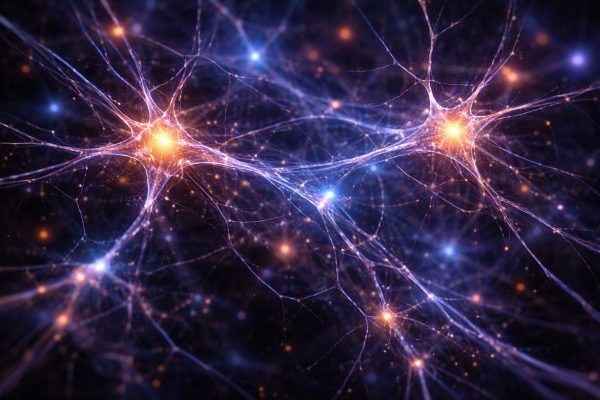
The brain and immune system communicate through dense intercellular networks, illustrating how multiple systems co-regulate homeostasis across levels
Your brain is another case study in emergent wonder. A hundred billion neurons, each one a fairly simple electrochemical switch, connected by a hundred trillion synapses. No single neuron understands language. No single neuron appreciates a sunset or regrets a poorly timed joke. But you do.
Consciousness, that slippery phenomenon that philosophers have argued about for millennia, arises from the interactions of cells that, individually, are about as sentient as a thermostat.
How does the meat become the mind? No one knows for certain. But emergence offers a framework: the properties of the whole are not reducible to the properties of the parts. Your experience of tasting chocolate or missing someone you love is not located in any particular neuron. It lives in the pattern, the dynamic, the conversation.
And then there is your immune system, perhaps the most underrated emergent masterpiece in your body. Billions of white blood cells patrol your tissues, each one following local rules, responding to molecular signals, attacking what seems foreign and sparing what seems self. No cell knows the full threat landscape. No cell has access to a master list of pathogens. And yet the system learns. It remembers. It adapts. It defends you against invaders it has never encountered, using a distributed intelligence that rivals any swarm.
Your immune response is not commanded from above. It emerges from below, a democracy of cells voting with cytokines instead of ballots.
This same distributed logic explains why chronic conditions rarely stay neatly contained. Pain, sleep disruption, mood instability, and inflammation often move together, because they arise from shared regulatory loops rather than isolated failures (a pattern we see repeatedly across the conditions we treat)
Takeaway: Your “self” is not stored in a single place, it emerges from coordinated activity across systems.
This is where the metaphor turns clinical: not parts obeying orders, but systems negotiating balance.

The Quiet Orchestration Beneath Awareness
What begins to emerge, if you’ll pardon the recursion, is a picture of the body as a conversation rather than a machine. Not a set of parts executing orders from a central command, but a network of networks, each layer influencing and being influenced by the others. Balance is not imposed. It is negotiated, moment by moment, through signals most of us never notice.
Consider how systems within you communicate across domains. A signal in one tissue ripples outward, modulating activity in distant organs. Stress in the gut echoes in the brain. Inflammation in one location whispers to the immune cells elsewhere. Sleep quality shapes mood shapes metabolism shapes sleep quality. The feedback loops are so densely interconnected that isolating any single cause becomes an exercise in frustration.
This is not a flaw in your biology. It is the signature of an emergent system, one that achieves resilience and adaptability precisely because no single component is in charge. Disrupt one pathway, and others compensate. Overwhelm the compensatory mechanisms, and dysfunction appears, not in one place, but across the web.
Healing, in this light, is not about fixing a broken part. It is about restoring the conditions under which the system can find its own balance again, an approach that quietly shapes how we think about care at CED Clinic. The body wants to cohere. It wants to regulate. It wants, in some deep and wordless way, to return to the dynamic equilibrium that emergence makes possible.
We are only beginning to understand the specific regulatory systems that maintain this equilibrium, the ones that modulate pain, mood, appetite, sleep, and immune function through distributed signaling networks. But understanding emergence helps us appreciate why such systems matter: they are the grammar of the body’s internal conversation, the syntax that allows trillions of cells to speak a coherent language.
Takeaway: Health behaves like an emergent negotiation, and symptoms often cluster because the loops are shared.
Emergent Systems All Around Us: Traffic, Markets, and the Grammar No One Wrote
Emergence is not confined to biology. Once you learn to see it, you find it everywhere humans gather and interact.
Traffic
Consider traffic. Each driver follows simple, self-interested rules: get where you’re going, don’t crash, maybe curse at the guy who cut you off. No driver intends to create a traffic jam. No driver wants to participate in that maddening stop-and-go wave that propagates backward through a highway for no apparent reason. And yet the jam emerges, a phantom bottleneck born from the mathematics of too many local decisions cascading through a constrained system.
Traffic engineers have learned they cannot solve congestion by focusing on individual drivers. They must address the emergent dynamics, the feedback loops, the tipping points where smooth flow crystallizes into gridlock. The jam is not a thing. It is a pattern, and patterns require pattern-level thinking.
Markets
Economies work similarly. No individual transaction creates inflation. No single investor causes a market crash. But aggregate the decisions of millions of buyers, sellers, savers, and speculators, and macroeconomic phenomena emerge that no participant intended or foresaw. Recessions are not planned. They are not the fault of any particular actor. They are emergent properties of a system too complex for any single mind to comprehend, let alone control.
Language
And then there is language, perhaps the most intimate emergent system of all. You are reading these words, parsing grammar, extracting meaning. But no one designed English. No committee voted on syntax. No authority decreed that subjects precede verbs or that adjectives stack in a particular order (it’s opinion-size-age-shape-color-origin-material-purpose, in case you were wondering, and you knew it intuitively without ever being taught).
Language evolves through use. Millions of speakers, each following rough conventions, each improvising at the edges, collectively generate a structure of breathtaking complexity. Children absorb it without instruction. Poets bend it without breaking it. The grammar lives in the community, not in any individual skull.
Simple rules. Local interactions. Global patterns no one authored. The signature of emergence, written across every domain of human experience.
Takeaway: When you see patterns nobody “designed,” you are often looking at emergence.
Even when the stakes are survival, coordination can look like a bridge built out of bodies.

Consciousness: The Hard Problem and the Humble Mystery
We arrive now at the deepest question emergence can pose: What about awareness itself?
You are reading these words. You know you are reading them. There is something it is like to be you, right now, in this moment. The redness of red. The ache of longing. The peculiar flavor of a Tuesday afternoon. Philosophers call this qualia, the subjective texture of experience, and no one has satisfactorily explained how it arises from electrochemical events in neural tissue.
This is the hard problem of consciousness, and emergence does not solve it. But emergence reframes it. Instead of asking where consciousness is, we might ask what conditions allow it to emerge. Instead of hunting for a soul in the synapses, we might recognize that awareness could be a property of a certain kind of complex, self-referential, dynamically integrated system.
Your brain is such a system. It not only processes information but processes information about its own processing. It models the world and models itself modeling the world. The loops fold inward until something strange happens: the system becomes aware that it exists.
Is this emergence? Perhaps. Or perhaps consciousness reveals the limits of the concept, the horizon beyond which our frameworks fail to illuminate. Either way, the lesson is humility. Emergent systems in biology teach us that the universe is capable of surprises, that wholes can be more than sums, that the simple can become astonishing without asking permission from reductionist explanations.
You are such an astonishment. Never forget that.
Takeaway: Emergence may not “solve” consciousness, but it helps us ask sharper, humbler questions.
Why Emergence Matters for Your Health: Restoring the Conversation
So what does any of this mean for you, sitting in a body that aches or a mind that races or a life that feels, some days, like too many disconnected pieces?
It means this: healing is not always about finding the broken part and fixing it. Sometimes, often, healing is about restoring the conditions under which your body’s emergent intelligence can reassert itself. The system wants to regulate. The conversation wants to cohere. Your job, and the job of anyone helping you heal, is to remove obstacles and provide support so the self-organizing magic can do what it does.
I think of a patient I’ll call Daniel. He came to me with chronic back pain, the kind that had resisted years of interventions, physical therapy, injections, medications that dulled the edges but never touched the center. He was exhausted. He was irritable. His sleep was fractured, his relationships strained, his work suffering. Pain had become the organizing principle of his life, and everything else orbited around it like debris around a black hole.
We began working together, and what unfolded was not a single fix but a cascade. As Daniel’s physical pain eased, even modestly, his sleep improved. Better sleep softened his emotional volatility. With more emotional bandwidth, he reconnected with his partner, started showing up more fully at work, began exercising again for the first time in years. Exercise further reduced his pain. Reduced pain deepened his sleep. The feedback loops that had been spiraling downward began spiraling upward instead.
Emergent states like health arise from multi-scale network interactions across physiology and environment, not from isolated parts: Emergent States Resulting From Adaptive Social and Biological Network Interactions (PMC article)
No single intervention saved Daniel. The improvement emerged from the interactions between interventions, each small gain amplifying the others. His body remembered how to balance. His life remembered how to cohere. The whole system found its way back to something like harmony.
This is what emergence looks like in clinical practice, not a single intervention, but a system gently nudged back into coherence. For patients who need guidance navigating that process, this is the kind of work we do. And it is why I have grown so interested in the regulatory systems that modulate multiple domains simultaneously, the ones that influence pain, mood, inflammation, sleep, and stress through distributed signaling networks.
The endocannabinoid system is one such network, a web of receptors and molecules that fine-tunes neural and immune activity throughout the body. (For more on how this system works, see our overview: CED Clinic FAQ – Endocannabinoid System Overview)
Understanding emergence helps explain why interventions targeting such systems can produce effects that seem disproportionate to the input. You are not adding a single ingredient. You are shifting the conditions under which the entire system operates. When the grammar of the body’s conversation improves, the whole dialogue changes.
Takeaway: In health, small improvements can cascade because feedback loops amplify what you change.
10 FAQ About Emergence
1. What are emergent systems in biology?
Emergent systems in biology refer to complex patterns or behaviors that arise when simple components interact according to basic rules, producing outcomes that no individual part could achieve alone. Think of a murmuration of starlings or the human immune system: the whole displays intelligence that no single bird or cell possesses. This concept helps explain how your body coordinates trillions of cells without a central command center issuing orders. It is one of nature’s most elegant tricks, and honestly, it makes middle management look a bit unnecessary.
2. How does emergence explain consciousness?
Consciousness remains one of science’s great mysteries, but emergence offers a useful framework for thinking about it. Rather than searching for awareness in a single neuron or brain region, emergence suggests that consciousness arises from the dynamic interactions of billions of neurons working together. Your brain not only processes information but processes information about its own processing, creating loops of self-reference that may give rise to subjective experience. Whether this fully explains the “hard problem” of consciousness is still debated, but emergence at least gives us a vocabulary for asking better questions.
3. Can slime mold really solve complex problems?
Remarkably, yes. Physarum polycephalum, a single-celled organism with no brain or nervous system, has been shown to solve mazes, find optimal paths between food sources, and even replicate the Tokyo rail network when given the right setup. It accomplishes this through internal feedback loops and chemical gradients, effectively computing solutions through its own body. The slime mold doesn’t “think” in any way we recognize, yet its behavior is demonstrably intelligent, a humbling reminder that cognition may be more about structure than substance.
4. What is swarm intelligence and how does it work?
Swarm intelligence describes the collective behavior that emerges when many simple agents, like ants, bees, or birds, interact according to local rules without central coordination. Each individual responds only to its immediate neighbors or environment, but the aggregate result is sophisticated problem-solving, decision-making, or navigation. Ant colonies optimize foraging routes, bee swarms select ideal nest sites, and fish schools evade predators with uncanny precision. No leader directs the action; the intelligence lives in the web of interactions itself.
5. How do emergent systems relate to human health?
Your body is an emergent system par excellence. Trillions of cells communicate through chemical signals, feedback loops, and regulatory networks to maintain balance across countless physiological processes. When these systems function well, health emerges naturally; when they become disrupted, dysfunction can ripple across multiple domains. Understanding this helps explain why holistic approaches, those addressing sleep, stress, nutrition, and movement together, often succeed where single-target interventions fail.
6. What is the endocannabinoid system’s role in emergence?
The endocannabinoid system is a distributed signaling network that modulates pain, mood, appetite, sleep, immune function, and more through receptors found throughout the body. It exemplifies emergent regulation: no single receptor or molecule controls the whole, but their interactions produce system-wide effects. This is why interventions targeting the endocannabinoid system can influence multiple health domains simultaneously, shifting the conditions under which the body’s self-organizing intelligence operates.
7. Why do birds flock in murmurations?
Murmurations arise from each bird following three simple rules: avoid crowding neighbors, align with their direction, and move toward the group’s center. No bird orchestrates the pattern; it emerges spontaneously from local interactions. Scientists believe flocking provides protection from predators and helps birds locate food and roosting sites. The visual result is breathtaking, a living river of wings that seems choreographed by some vast, invisible conductor.
8. How can understanding emergence improve medical treatment?
Recognizing the body as an emergent system shifts the focus from fixing isolated parts to restoring conditions for self-organization. Chronic conditions often involve multiple interconnected dysfunctions, and addressing them requires thinking in terms of feedback loops, not just broken components. A patient whose pain affects sleep, mood, and relationships may improve dramatically when interventions cascade positively through these domains. Emergence invites clinicians to think like ecologists, tending the whole garden rather than pulling single weeds.
9. What everyday examples demonstrate emergence?
Traffic jams emerge from individual driving decisions even though no driver intends to create gridlock. Economic recessions arise from countless transactions without any person planning a downturn. Language evolves through collective use without a committee designing grammar. Even your morning coffee shop has emergent properties: the culture, vibe, and unwritten rules develop from customer and staff interactions, not from a corporate manual. Once you see emergence, you see it everywhere.
10. Is emergence the same as complexity?
Not quite, though they’re related. Complexity refers to systems with many interacting parts, while emergence specifically describes the novel properties or behaviors that arise from those interactions, properties not predictable from the parts alone. A pile of sand is complex but not particularly emergent; a pile of neurons becomes a mind. Emergence is complexity’s surprise party, the moment when quantity transforms into something qualitatively new.
Now return to the beginning, and let the ending feel like an ending.

Returning to the Murmuration: A Closing Reflection
Let us end where we began, at dusk, with starlings.
They are still rising, still swirling, still performing their impossible ballet against the fading Roman sky. No bird knows the shape of the flock. No bird perceives the beauty it helps create. And yet the beauty is real. The intelligence is real. The pattern is as genuine as any individual wing.
You are both the bird and the flock. You are the neuron and the thought, the cell and the self, the simple rule and the surprising result. The emergence that created you is the same emergence that animates ant colonies and slime molds and the traffic outside your window. You are part of something larger than you can perceive from the inside, and that something is not separate from you. It is you, in the only way you can be.
This is not mysticism. It is biology, taken seriously. It is the recognition that complexity is not a problem to be solved but a phenomenon to be respected. And it is an invitation to approach your own health, your own healing, your own life, with a certain wonder.
The whole knows things the parts never learned. Trust the conversation. Support the balance. And when you watch the starlings next, remember: you are watching yourself.
Takeaway: The whole can carry meaning the parts cannot see from the inside.