What This Lancet Review Really Says About Cannabinoids in Psychiatry
A physician-guided reading of a new randomized-trial synthesis, with close attention to what was studied, what was not, and where public interpretation may run wider than the data.
TL;DR
This new Lancet review pooled 54 randomized trials and found a thin, uneven evidence base for cannabinoids in mental disorders and substance use disorders.
A few signals appeared in cannabis use disorder, sleep-time outcomes in insomnia, tic severity, and autism-related measures.
Most outcomes were low certainty, and 44% of included trials were high risk of bias.
All-cause adverse events were more common, while serious adverse events and withdrawals were not clearly higher.
What You’ll Learn in This Post
Why this paper matters right now
Cannabinoids for mental disorders sit in an unusually noisy part of medicine. Patient experience, mechanistic plausibility, product marketing, public controversy, and randomized evidence often get blended together as though they carry equal weight. They do not.
This review matters because it tries to separate those layers. It asks a more disciplined question: what do randomized controlled trials actually show when plant-based or pharmaceutical cannabinoids are used as treatment for mental disorders or substance use disorders? That is a narrower question than most headlines will imply, and it is exactly why the paper is worth reading carefully.
What this review actually studied
This was not a review of all real-world cannabis use for mental health. It was a review of randomized controlled trials in which plant-based or pharmaceutical cannabinoids were used as the primary treatment for mental disorders or substance use disorders. That distinction matters because a short placebo-controlled trial of a specific oral product is not the same thing as individualized, longitudinal cannabinoid care.
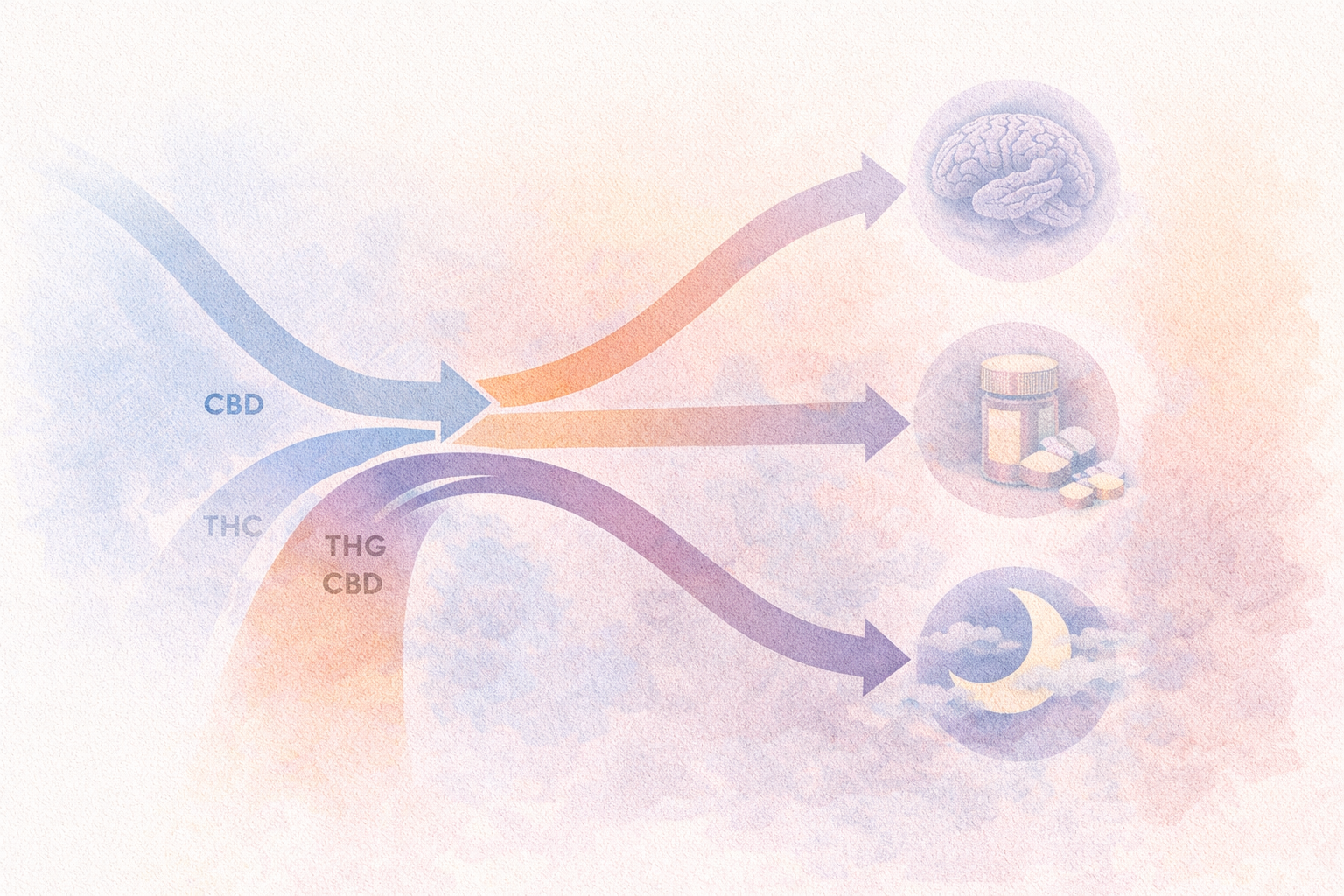
The paper included 54 randomized trials with 2,477 participants overall. Treatments were usually brief, averaging about five weeks. Products varied, but the review distinguished among CBD, THC, and mixed THC/CBD formulations rather than treating every cannabinoid exposure as identical.
Where cannabinoids for mental disorders showed signals, and where they did not
The broad pattern was not impressive. No significant pooled benefit emerged for anxiety disorders, psychotic disorders, post-traumatic stress disorder, anorexia nervosa, or opioid use disorder. There were insufficient data to meta-analyze ADHD, bipolar disorder, obsessive-compulsive disorder, or tobacco use disorder, and there was no randomized evidence at all for depression treatment.
That matters because some of those conditions, especially anxiety, PTSD, and sleep complaints, are among the most common reasons people talk about cannabinoids in psychiatric care. The gap here is not subtle. It is the distance between how often cannabinoids are discussed and how much randomized evidence clearly supports that discussion.
At the same time, the review did not come back entirely empty. Favorable signals appeared in cannabis use disorder, especially for withdrawal symptoms and cannabis-use outcomes, in insomnia-related sleep-time outcomes, in tic or Tourette syndrome, and in autism-related measures. Those signals deserve attention. They do not justify a sweeping victory lap.

Why exposure definition changes the meaning of the result
One of the better features of this review is that it does not fully collapse CBD, THC, and mixed formulations into one undifferentiated category. Even so, the evidence base remains heterogeneous in ways that matter clinically. Dose, route, formulation, treatment goal, prior cannabis exposure, and whether a product is being used as primary or adjunctive therapy can all change the meaning of the outcome.
That is why a broad conclusion about cannabinoids for mental disorders can easily sound firmer than the underlying literature really is. A null pooled result for a heterogeneous class is not always the same thing as a cleanly negative answer for every product-condition pair. The reverse is true too. A small favorable result for one setting does not validate a whole therapeutic category.
This is one reason study-interpretation literacy matters so much in cannabinoid medicine. Definitions are not housekeeping. They are the study.
Why trial length and outcome selection matter so much here
Most studies in the review were short. That may be enough to detect early symptom change, but it is not enough to fully understand durability, tolerance, dependence risk, functional tradeoffs, or whether the early benefit continues to matter after the novelty of treatment fades.
The insomnia findings offer a useful example. Sleep time improved in some analyses, which is meaningful. But broader insomnia outcomes were not uniformly strong. Sleeping longer and actually resolving insomnia are related, but not identical. The same principle applies across psychiatric care. A measured signal on one endpoint is not the same thing as broad syndrome-level confidence.
Outcome selection shapes the story people think they are hearing. If the public hears “insomnia improved,” they may picture deep, restored sleep. What the trial may actually show is something narrower. Those distinctions deserve more respect than they usually get.
Safety is part of the story, but not the whole story
The review found higher odds of all-cause adverse events with cannabinoids. That matters. It should not be waved away. At the same time, serious adverse events and study withdrawals were not clearly higher in pooled analyses, which makes the safety picture more nuanced than a simple danger headline would suggest.
In clinical life, many treatments fail not because they are catastrophic, but because the tradeoff does not feel worth it. Sedation, dizziness, cognitive slowing, gastrointestinal discomfort, anxiety, or a sense of functional drag can all matter quite a lot even when a treatment does not generate a sharp signal for severe events. That is especially true in psychiatry, where the question is often whether a patient feels and functions better, not just whether a symptom scale moved.
What this study does not show
It does not show that all cannabinoids fail in psychiatry. It also does not show that cannabinoids are broadly validated for psychiatric care. Those are the two most predictable distortions, and both go further than the paper can responsibly support.
It does not show that a short randomized trial of a specific cannabinoid product should be treated as equivalent to individualized, physician-guided, longitudinal care. It also does not show that individualized care automatically succeeds where randomized evidence is weak. The more honest answer is less satisfying: this remains a field with pockets of promise inside an evidence base that is still immature and uneven.
It also does not answer several important questions because the randomized literature is simply too thin. Depression is the clearest example. Absence of evidence is not proof of failure. It is an evidence gap, and good interpretation keeps those two ideas separate.
Where the closing language may run wider than the data
The authors conclude that routine cannabinoid use for mental disorders and substance use disorders is currently rarely justified. I understand why that sentence appears in the paper. The randomized evidence base is thin, uneven, and often low certainty.
Still, that sentence is broader than some of the underlying product-specific signals. It works best as a policy-level caution, or as a warning against enthusiastic overgeneralization. It works less well as a total bedside rule that erases formulation-specific nuance, indication-specific signals, or carefully bounded clinical judgment.
Two things can be true at once. The literature is weaker than many enthusiasts suggest. The final sentence of the paper is broader than the narrowest, most defensible reading of the underlying evidence.
How clinicians and patients should think about this review now
The most responsible response is humility, not hype and not panic. Cannabinoids for mental disorders remain a topic where precision matters more than rhetoric. Product selection matters. Route matters. Outcome definition matters. Follow-up matters. So does honesty about the limits of what the literature can currently support.
For clinicians, the paper raises the bar for precision and documentation. For patients, it is a reminder that feeling helped and proving efficacy are not the same thing, even though both deserve respect. The safest place to stand is usually the middle ground, where evidence gaps are acknowledged and overclaiming is unwelcome.
Key study parameters at a glance
A guided pathway for readers who want more context
Cannabis and psychiatric disorders offers a wider frame for how these questions have been discussed across conditions.
Cannabis and mental health helps place study findings inside a broader clinical conversation without flattening nuance.
This CBD sleep trial review is useful if the insomnia signal is the piece you want to read more carefully.
This substitution discussion addresses a different clinical question than placebo-controlled efficacy trials do.
This Tourette syndrome page may help if the tic-related findings are the most relevant part of the review for you.
Frequently asked questions
What did this Lancet review actually study?
It reviewed randomized controlled trials in which plant-based or pharmaceutical cannabinoids were used as treatment for mental disorders or substance use disorders. That is narrower than asking whether all forms of cannabis help all psychiatric symptoms in real-world care. The distinction matters because trial-tested products, routes, and durations are much more specific than the public conversation usually is.
Did the review find benefit for anxiety disorders?
No significant pooled benefit was found for anxiety disorders in this review. That does not mean cannabinoids can never help anxiety in any patient. It means the randomized evidence gathered here did not support a clear pooled benefit strong enough to carry broad conclusions.
Did the review find benefit for PTSD?
No significant pooled benefit was found for post-traumatic stress disorder. The more important point is that the PTSD literature remains relatively small, which limits confidence in either direction. Lack of clear evidence is not identical to proof of no effect.
Which conditions showed the strongest signals?
The clearest favorable signals appeared in cannabis use disorder, insomnia-related sleep-time outcomes, tic or Tourette syndrome, and autism-related measures. Even there, much of the supporting evidence was low or very low certainty. These findings are better read as limited signals than as settled standards of care.
Were cannabinoids more dangerous in the review?
All-cause adverse events were more common with cannabinoids than with control conditions. Serious adverse events and study withdrawals were not clearly higher in pooled analyses. That pattern argues for caution and precision, not alarmism.
Why does trial length matter so much?
Most of the included trials were short, averaging about five weeks. Psychiatric care usually unfolds over much longer horizons. Short studies can capture early symptom change, but they do a weaker job showing durability, tolerance, dependence risk, functional tradeoffs, and longer-term value.
Does this review settle the question of medical cannabis and mental health?
No. It narrows the question, which is valuable, but it does not settle it. The paper is strongest as a summary of randomized evidence for specific cannabinoid interventions used in specific ways, not as a universal verdict on every real-world psychiatric use case.
What is the biggest public risk in how this paper may be used?
The likeliest misuse is oversimplification. Some readers will say the paper proves cannabinoids do not help mental health, while others will cherry-pick the positive signals and ignore the low certainty. Neither reading is especially careful, and both flatten the real message.
Why do formulation differences matter so much?
CBD, THC, and mixed THC/CBD products are not clinically interchangeable. Different ratios, doses, routes, and treatment goals can lead to meaningfully different effects and side-effect profiles. Pooling them under a broad cannabinoid umbrella helps with synthesis, but it can blur clinically important distinctions.
What is the fairest takeaway for clinicians and patients?
The fairest takeaway is that psychiatric cannabinoid care remains ahead of the strongest evidence base in many indications. That does not make every use unreasonable, but it does raise the bar for caution, documentation, product matching, and follow-up. The paper supports more careful medicine, not louder rhetoric.
References
Wilson J, Dobson O, Langcake A, et al. The efficacy and safety of cannabinoids for the treatment of mental disorders and substance use disorders: a systematic review and meta-analysis. Lancet Psychiatry. 2026;13:304-315. DOI
Black N, Stockings E, Campbell G, et al. Cannabinoids for the treatment of mental disorders and symptoms of mental disorders: a systematic review and meta-analysis. Lancet Psychiatry. 2019;6(12):995-1010. PubMed
Hindley G, Beck K, Borgan F, et al. Psychiatric symptoms caused by cannabis constituents: a systematic review and meta-analysis. Lancet Psychiatry. 2020;7(4):344-353. PubMed
This post is an evidence interpretation piece, not individualized medical advice. The point is not to flatten complexity. It is to restore it where public conversation tends to lose it.