
Adolescent Cannabis Use and Psychosis Risk: What This Cohort Study Shows
What this large cohort study shows, what it does not measure, and how to discuss risk without overstating it.
Adolescent cannabis use and psychosis risk remain central concerns in youth mental health research. In this large cohort, adolescents reporting past-year cannabis use were later diagnosed with certain psychiatric disorders at higher rates.
This review examines how adolescent cannabis use is associated with later psychiatric diagnoses, including psychotic and bipolar disorders, within a large observational study design. It also explains what the study does not measure and why causal language must remain disciplined.
TL;DR
- Adolescents reporting past-year cannabis use had higher subsequent rates of psychiatric diagnoses.
- The strongest associations were observed for psychotic and bipolar disorders; depression and anxiety associations were smaller.
- Exposure was defined as binary self-report, without modeling dose, potency, frequency, or persistence.
- Outcomes were ICD-coded diagnoses, not direct measures of neurodevelopment or brain structure.
- The design does not establish causality. Confounding, surveillance effects, and reverse causation remain viable explanations.
Why This Paper Deserves Careful Reading
Public discussions about adolescent cannabis often drift toward extremes. One side minimizes risk entirely. The other frames any association as proof of neurological harm.
This study sits between those poles. It identifies a risk signal that should not be ignored, and it also includes measurement features that meaningfully constrain interpretation.
Precision matters here. “Associated with higher rates of diagnosis” is not the same claim as “proven neurodevelopmental injury.” Those are different scientific statements.
What Was Actually Measured
Exposure
Cannabis exposure was defined as a yes or no response to past-year use on a confidential adolescent screening questionnaire administered during well visits. That is a binary exposure definition.
Outcomes
Psychiatric outcomes were identified using ICD-10 diagnosis codes within the electronic health record. This approach captures clinician-assigned diagnoses, not imaging findings, cognitive testing results, or biological markers.
Interpretation Boundary
Because this is an observational cohort analysis, the results describe associations within a defined population and time frame. The study does not demonstrate that cannabis caused the diagnoses observed.
What the Study Shows
Adolescents who reported past-year cannabis use were diagnosed with psychotic and bipolar disorders at higher rates during follow-up than those who did not report use. Associations for depressive and anxiety disorders were present but more modest.
The signal for psychotic and bipolar diagnoses is not small, and it should not be dismissed. At the same time, the strength of association alone does not settle questions of mechanism.
What the Study Does Not Show
The analysis does not include neuroimaging, neuropsychological testing, or direct measurement of brain development. It does not quantify THC concentration, product type, frequency of use, or duration of exposure.
Occasional experimentation and sustained heavy use are grouped together in the primary exposure definition. As a result, the study cannot determine whether risk differs meaningfully across intensity levels. That distinction is clinically important.
The Limitations That Matter Most
1) Binary exposure collapses real-world variability
A single affirmative response includes adolescents who experimented once and those using regularly. Without separating frequency, potency, or persistence, gradient effects cannot be evaluated.
2) Dose-response patterns were not directly modeled in the primary exposure definition
When risk increases with greater exposure intensity, causal interpretation strengthens. If exposure is coarse, that test becomes impossible. The design does not eliminate confounding through gradient analysis.
3) ICD-coded diagnoses reflect care processes
Diagnosis codes emerge from clinical encounters. They reflect referral patterns, documentation habits, and healthcare access in addition to symptom burden.
4) Internalizing outcomes are heterogeneous
Depression and anxiety categories include unspecified and adjustment-related codes. Some represent transient stress reactions rather than stable syndromic illness.
5) Surveillance effects remain plausible
Adolescents who disclose cannabis use may receive closer monitoring or earlier behavioral health referral. Increased diagnostic attention can influence observed rates even if underlying disease incidence is unchanged.
6) Reverse causation cannot be ruled out
Sleep disruption, anxiety, mood volatility, trauma-related symptoms, and early psychotic features can precede both cannabis use and formal diagnosis. In such cases, symptoms may drive exposure rather than the reverse.
7) Residual confounding is difficult to eliminate
Family psychiatric history, genetic vulnerability, peer environment, trauma exposure, and co-occurring substance use can influence both cannabis exposure and psychiatric diagnosis. Even careful adjustment may leave important shared liability unmeasured.
In practical terms, this study detects a meaningful association. It does not fully disentangle whether that association reflects causation, clustering of vulnerability, or a combination of both.
Clinical Translation
The responsible clinical posture is neither dismissal nor alarmism. It is careful screening paired with clarity about what the evidence does and does not establish.
In practice
Ask adolescents who report cannabis use about sleep, anxiety, mood stability, trauma exposure, concentration, school function, and family psychiatric history. When psychiatric symptoms appear, inquire specifically about frequency and potency of cannabis exposure rather than relying on yes or no categories.
What this supports saying aloud
“In a large cohort, adolescents reporting past-year cannabis use were later diagnosed with certain psychiatric disorders at higher rates. This does not prove causation, but it supports taking early use seriously, especially in youth with underlying vulnerability.”
Related reading: Cannabis and mental health, Cannabis and pregnancy, Pediatric safety and evidence.
Primary Source Documents
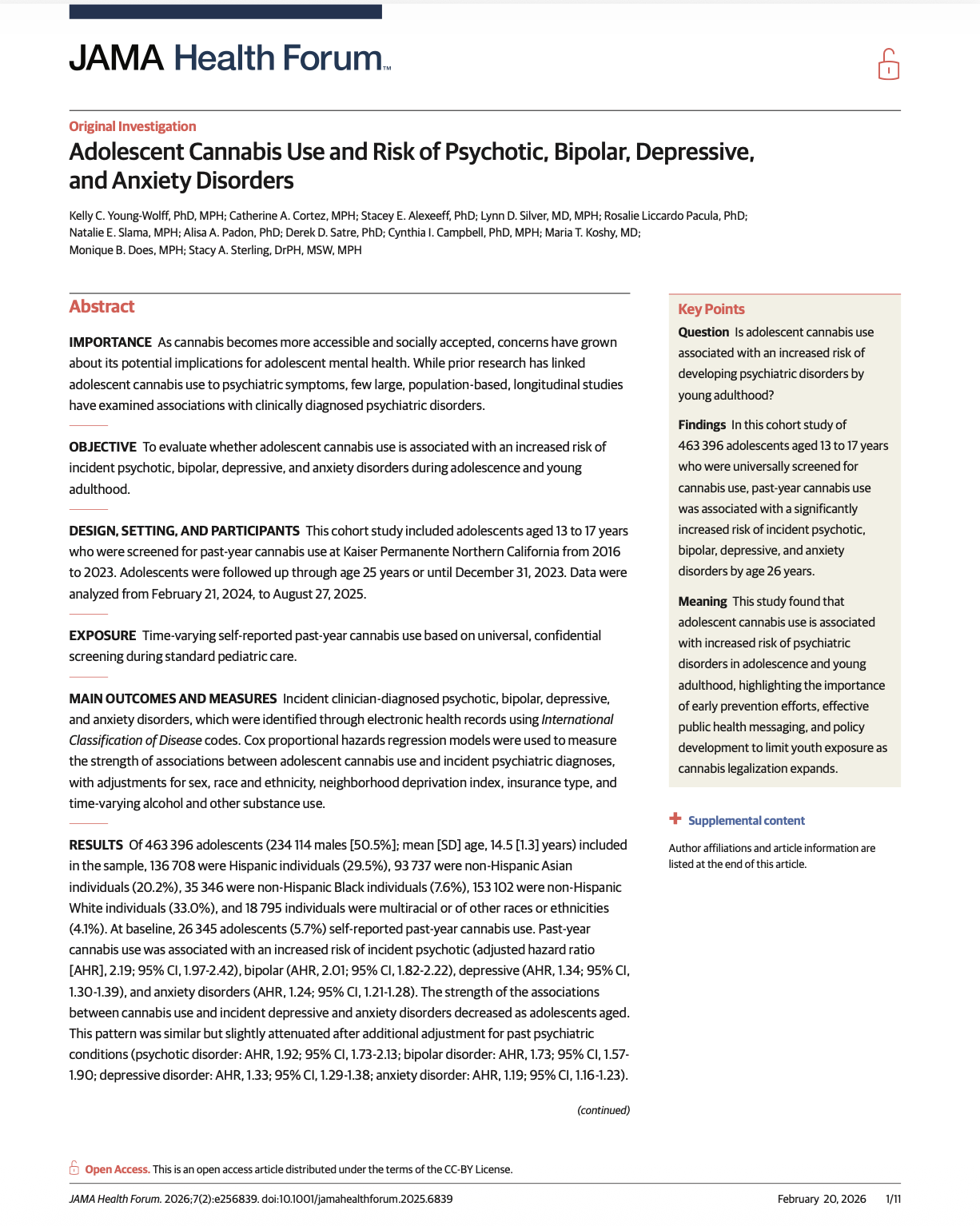
Click the image to open the peer-reviewed JAMA Health Forum article analyzed in this review.
Study PDF: Open the published paper
Concise Summary
A large observational cohort study reports that adolescents who self-report past-year cannabis use have higher subsequent rates of psychiatric diagnoses, particularly psychotic and bipolar disorders. Exposure was defined as binary self-report without modeling dose, potency, frequency, or persistence. Outcomes were ICD-coded diagnoses rather than direct neurodevelopmental measures. The design does not establish causality, and confounding, surveillance effects, and reverse causation remain plausible.
How Confounders Can Create This Exact Pattern
Observational associations can be real and clinically important, while still reflecting multiple upstream pathways. Below are concrete examples of how known confounders and care-process effects can produce the same statistical pattern seen in this study, without proving direct causation.
1) Family vulnerability
If adolescents with a strong family history of psychotic or bipolar disorders are more likely to experiment with cannabis and also more likely to develop those diagnoses regardless, cannabis use can appear associated with later illness even if it is not the primary driver.
Analogy: Two branches from the same tree.
2) Early symptoms before diagnosis
Sleep disruption, anxiety, mood volatility, trauma-related distress, or subtle psychotic-spectrum symptoms can precede both cannabis use and the first recorded diagnosis. If early symptoms lead to cannabis use before a diagnosis is entered, cannabis can statistically predict diagnosis.
Analogy: Taking pain medicine before the doctor documents the injury.
3) Trauma exposure
Trauma exposure increases risk for later psychiatric illness and also increases risk for substance use. If trauma is not measured with sufficient resolution, cannabis exposure can partially absorb the association that belongs to trauma.
Analogy: Blaming the smoke alarm for the fire.
4) Peer environment and social context
Adolescents in higher-risk peer networks may be more likely to use cannabis and more likely to experience destabilizing stressors. The shared environment can be the upstream driver, making cannabis look like the cause when it is part of a broader context.
Analogy: Same neighborhood, same exposures, different labels.
5) Surveillance effects and diagnostic attention
Adolescents who disclose cannabis use may receive closer monitoring, more screening, or earlier referral to behavioral health. Increased diagnostic attention can raise recorded diagnosis rates even if underlying disease incidence is unchanged.
Analogy: You find more “problems” when you look harder.
6) Shared liability across multiple risks
Genetic liability, family stress, early adversity, school disruption, and other substance use can increase both the likelihood of cannabis use and the likelihood of psychiatric diagnosis. Even careful adjustment can leave meaningful shared vulnerability unmeasured.
Analogy: One upstream current feeding two downstream rivers.
7) Exposure misclassification from a binary definition
Past-year cannabis use was categorized as yes or no. That groups together a teen who tried cannabis once and a teen using daily. Without modeling frequency, potency, persistence, or product type, interpretation becomes blurred and dose-response cannot be cleanly tested.
Analogy: Counting “exercise” without tracking intensity or frequency.
8) Outcome coding variability
ICD-10 diagnoses reflect clinical documentation, referral pathways, and healthcare access. They are clinically meaningful, but they are not the same as adjudicated diagnostic interviews or direct biological measurement. Coding differences can influence apparent rates.
Analogy: Labeling a folder from the cover note rather than reading every page inside.
Confounding does not mean “no risk.” It means multiple pathways can generate similar statistical patterns. The correct posture is risk-aware counseling with causality-disciplined interpretation.
FAQ
Does this study prove cannabis causes psychosis or bipolar disorder?
No. It demonstrates an association within an observational design. Causality requires stronger evidence than this study alone can provide.
Does the study measure brain damage or neurodevelopmental injury?
No imaging, neurocognitive testing, or biomarker assessments were included. The outcomes are clinician-coded diagnoses.
Can it distinguish occasional from heavy use?
Not in the primary exposure definition. The study categorizes past-year use as yes or no, without modeling intensity or duration.
Why does dose response matter?
When higher exposure corresponds to higher risk, causal interpretation strengthens. Without that gradient analysis, alternative explanations remain open.
References
- Young-Wolff KC, et al. Adolescent Cannabis Use and Risk of Psychotic, Bipolar, Depressive, and Anxiety Disorders. JAMA Health Forum. 2026;7(2):e256839. doi:10.1001/jamahealthforum.2025.6839.
- Supplement 1 accompanying the above article.
- Marconi A, Di Forti M, Lewis CM, Murray RM, Vassos E. Meta-analysis of the association between level of cannabis use and risk of psychosis. Schizophrenia Bulletin. 2016;42(5):1262-1269.
- Gobbi G, Atkin T, Zytynski T, et al. Association of cannabis use in adolescence and risk of depression, anxiety, and suicidality. JAMA Psychiatry. 2019;76(4):426-434.